

Modern data platforms have become incredibly good at centralizing data.
With solutions like Microsoft Fabric, organizations can bring together operational systems, analytics workloads, and AI capabilities into a single unified environment. Data from ERPs, CRMs, operational systems, and IoT platforms can now live side-by-side in OneLake.
But even with all of this consolidation, a major problem still exists.
The meaning of the data is often disconnected from the business.
Tables, schemas, and pipelines tell us how data is stored, but not necessarily what it means in the real world.
This is exactly the problem that ontology in Microsoft Fabric aims to solve.
The Semantic Gap in Modern Data Platforms
Most modern data architectures focus heavily on technical organization:
- Data is organized into domains like Sales, Finance, or Operations
- Models reflect the structure of source systems
- Reports answer domain-specific questions
- Cross-domain understanding requires complex joins and domain knowledge
Even when semantic models exist, they typically remain limited to reporting workloads.
Business knowledge and how concepts relate across the organization often lives in:
- tribal knowledge
- documentation
- business analysts’ heads
- transformation logic buried in pipelines
This creates a semantic gap between data systems and business understanding.
In other words, we have the data, but not the shared language that explains how the business actually works.
Enter Fabric IQ and Ontology
Microsoft recently introduced Fabric IQ, a new capability in Microsoft Fabric designed to create a unified business understanding layer on top of data stored in OneLake.
Fabric IQ consists of several components that work together to make data more interpretable and AI-ready:
- Ontology
- Graph in Microsoft Fabric
- Fabric Data Agent
- Operations Agent
- Power BI Semantic Models
Among these, Ontology plays the foundational role.
Ontology provides the structured definition of business concepts and relationships that allows systems and AI to understand the meaning of the data.
Ontology encourages us to think about the business objects, not database artifacts.
What is an Ontology?
In the context of Microsoft Fabric, an ontology is a structured representation of business knowledge.
It defines:
- Business entities
- Their attributes
- The relationships between them
This transforms raw data into governed business objects that are understandable across teams and systems.
An ontology helps organizations move from technical schemas to business concepts.
This shift may seem subtle, but it fundamentally changes how data is understood and used. Ontology creates a shared meaning layer across systems and domains, allowing data to be interpreted consistently across the organization.
A Simple Real-World Ontology Example
To understand ontology better, let’s look at a conceptual model. In this example, we use a restaurant ecosystem to demonstrate how business concepts relate to each other.
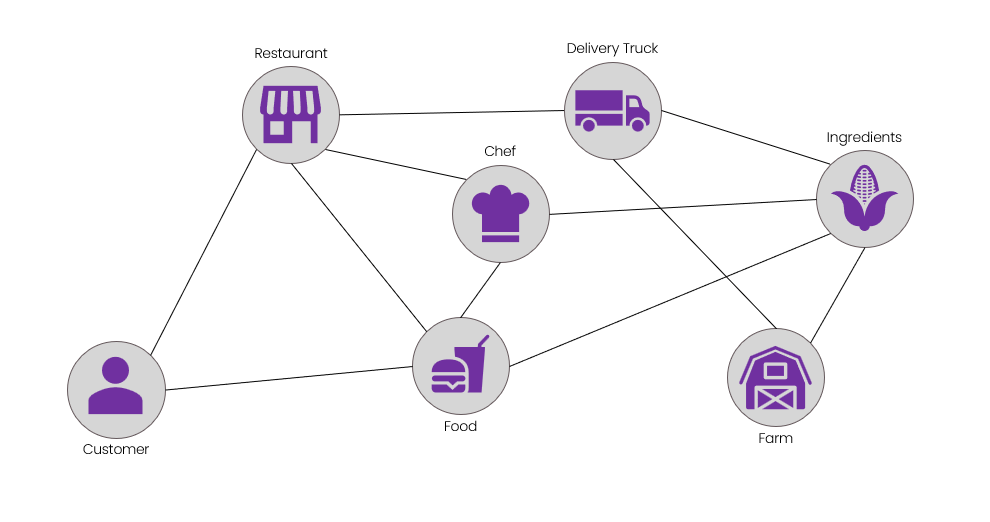
Entities might include:
- Customer
- Restaurant
- Food
- Chef
- Farm
- Ingredients
- Delivery Truck
Instead of thinking about this as tables and joins, ontology represents it as a graph of connected business concepts.
For example:
- Customer > orders > Food
- Restaurant > prepares > Food
- Chef > cooks > Food
- Food > contains > Ingredients
- Farm > supplies > Ingredients
- Delivery Truck > delivers > Food
This creates a knowledge graph of the business ecosystem. Ontology formalizes these relationships so that both people and AI systems understand them consistently.
Core Components of a Fabric Ontology
Microsoft Fabric ontology is built around several core building blocks.
Entity Types
An entity type represents a standardized business concept.
Examples include:
- Customer
- Product
- Order
- Restaurant
- Ingredient
Each entity type defines:
- identifiers
- attributes
- metadata
- classification rules
These definitions ensure that the meaning of an entity is consistent across the entire organization.
Entity Instances
Entity instances represent specific occurrences of an entity type.
For example:
- Customer → Samson Truong
- Restaurant → Samson’s Diner
- Food → Cheeseburger
Instances are created from bound data and allow the ontology graph to represent actual business activity.
Properties
Properties describe the attributes of an entity.
For example, a Food entity might include:
- Name
- Category
- Calories
Properties ensure that attributes follow a consistent structure and data type, improving both data quality and clarity across systems.
Relationships
Relationships define how entities connect to each other.
Examples include:
- Customer orders Food
- Restaurant prepares Food
- Farm supplies Ingredients
These relationships are directional and can include additional metadata such as:
- effective dates
- distance
- confidence
- cardinality rules
By explicitly defining relationships, ontology turns hidden transformation logic into discoverable business knowledge.
Data Binding
Ontology definitions alone are not enough. They must be connected to real data.
This process is called data binding, where ontology concepts are mapped to actual data stored in OneLake.
Data binding defines:
- how entity properties map to source columns
- how keys establish relationships
- how identity is standardized across systems
Once bound, raw records become governed business objects that can be used consistently across applications.
The Ontology Graph
Once entities, properties, relationships, and bindings are defined, Fabric generates an ontology graph.
This graph represents:
- entities as nodes
- relationships as edges
The graph is queryable and supports exploration of business relationships. It also preserves data lineage and source context.
This allows analysts and AI systems to navigate business meaning directly, rather than reconstructing relationships through SQL joins.
Querying with Ontology
One of the most powerful capabilities of ontology is business-driven querying. Instead of writing queries based on physical schemas, users can query using ontology terms. The ontology layer then routes the request to the appropriate data engine automatically while ensuring joins, filters, units, and rules follow governed business definitions. With support from Fabric Data Agents, users can ask questions in natural language, which are translated into structured ontology queries. This removes the need to understand where data is stored or how it is structured in the underlying systems.
Why Ontology Matters
Ontology introduces a shift in how organizations think about data.
Instead of focusing on tables and pipelines, the focus moves to business meaning.
Key benefits include:
Business Alignment
Ontology ensures that teams, tools, and AI systems operate using the same conceptual model of the business.
Discoverable Relationships
Business relationships are explicitly defined rather than hidden inside ETL logic.
Transparency and Traceability
Rules, lineage, and definitions are embedded directly into the conceptual layer.
AI Readiness
AI systems perform best when they have structured context, not just raw data. Ontology provides that context.
Agentic Workflows
Operational agents can safely perform actions when they understand the business objects and rules governing them.
Getting Started with Fabric Ontology
A practical way to begin using ontology in Fabric is by leveraging something many organizations already have: Power BI semantic models.
Fabric can generate a foundational ontology directly from an existing semantic model.
This process converts:
- tables
- measures
- relationships
into ontology components such as entity types and relationships.
From there, teams can refine and extend the ontology to better reflect real business workflows.
This approach accelerates adoption because it builds on existing curated business logic rather than starting from scratch.
Final Thoughts
Ontology represents an important evolution in the data platform.
For years, organizations focused on solving the data consolidation problem.
Microsoft Fabric solves much of that with OneLake and unified workloads.
Ontology now tackles the next challenge: Giving data shared meaning across the business.
By transforming technical schemas into governed business concepts and relationships, Fabric ontology creates a foundation that supports:
- analytics
- AI
- automation
- operational intelligence
And perhaps most importantly, it ensures that everyone from analysts to AI agents is speaking the same data language.
Leave a Reply